
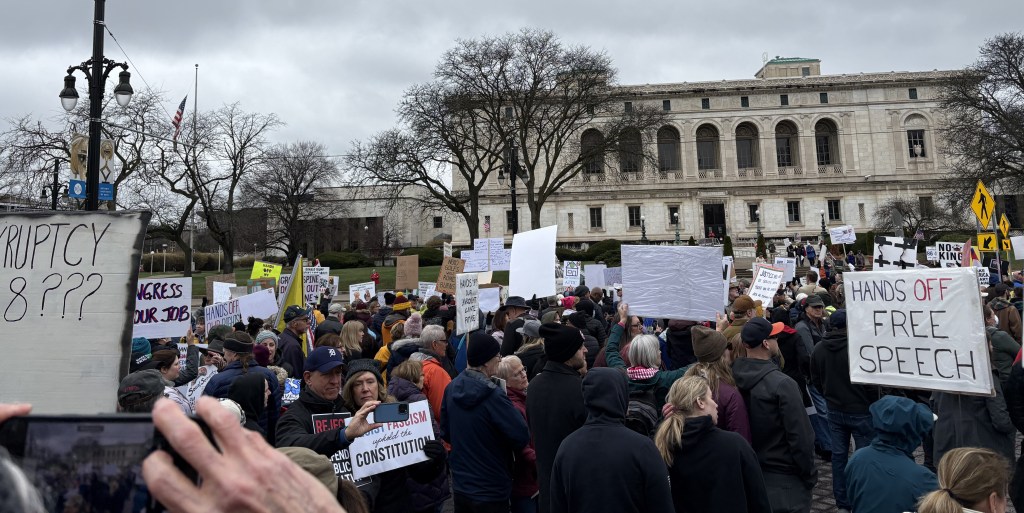
Above: Hands Off Demonstration, Detroit Institute of Arts (DIA) on April 5th 2025
She never really left—but now she’s back with something even bigger.
Joann Castle, a longtime Detroit activist, BookLife Prize winner, and author of What My Left Hand Was Doing: Lessons from a Grassroots Activist, is reorganizing her work with a powerful new platform for intergenerational organizing. The book that captured the roots of her journey was first published by Against the Tide Books in 2018, but the mission is alive and more relevant than ever.
Welcome to http://www.WhatMyLeftHandWasDoing.com, a new online hub where readers, students, and activists can engage with Joann’s work in real time. At the heart of this revitalization is “The Activist’s Survival Guide” — the 11-point toolkit introduced in the original book, now being expanded to meet the demands of this political moment.
A second edition of the book is in progress, featuring a new prologue, epilogue, and revised principles that address today’s urgent calls for justice, democracy, and cross-generational collaboration. From street protests to policy fights to kitchen-table organizing, Joann’s new work speaks to the moral clarity — and practical strategy — we need now.
Come join us. Learn, reflect, organize, and pass it on.

By Joann Castle.
Welcome to friends old and and new. It’s so nice to be with you again.
“If you want change, you need to show up. If you don’t show up, there will be no change.”
Our new administration has been in power for 100 days. Day one, they declared a southern border crisis and have been using this manipulation to bulldoze our governmental structures. International commitments to our allies: abandoned. Civil liberties: erased. They have installed an oligarchy of billionaires and misfits to run our country, guided by “Project 2025.” They are dismantling our democratic institutions piece by piece. The speed of the destruction is dizzying.
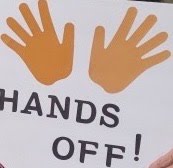
Word began to spread about plans for a Detroit “Hands Off!” action on Saturday, April 5th, 2025. There was no question in my mind. I had to get my feet on the street and dispel the emotional distress inside me by taking action. I had been hearing about folks being accosted and swept away out of the country with no due process. Fear was in me, but I had to go. It was time to plant my feet on the ground and let the world know that I care.
Yes! We want free speech and due process. We want a country that follows the rule of law. No, you can’t take our Medicaid or our Social Security. No, you may not shut down our public schools or replace them with taxpayer-funded religious schools!

It was a wet morning but the rain soon stopped. My friends and I were on our way to the “Hands off” mobilization. As we boarded the PeopleMover (Detroit’s version of a skyway), a reporter approached us and and began asking questions. My friends stepped back and gave me a gentle push towards the microphone.
Reporter: What brought you here today?
Answer: I had to put my body on the line. I had to speak for what I believe in. Over the years, the People have won many battles by showing up to fight back, using nonviolent resistance. Think of the 381-day Montgomery, Alabama Bus Boycott in 1955. Or more recently, demonstrations at the end of Trump’s first term that ended his policy of Separating Family’s at the border. I’ve been following events closely since the early Civil Rights Movement.
Reporter: How is today different than the Civil Rights Movement?
Answer: Back then, during the Civil Rights Movement, we organized by word of mouth. There was no social media and only limited telephone service. To communicate, you had to write letters and wait for the mailman to deliver a response. An old telegraph machine would have been faster.
For a brief history of the Civil Rights movement click here.
There were fewer signs, usually at the front of a march, sometimes painted on a white bedsheet. Leaders used bull horns to communicate with the crowds. As technology advanced, rudimentary copy machines became available, making it possible (but expensive) to make flyers. In the city, speakers often pulled up in a Black community jumping up on a flatbed truck with only a microphone. Folks gathered around to hear the news. From a historical perspective, it’s fascinating to see how quickly technology has changed our tools and how that changes us. How we live. How we organize. How we survive.
Observations at the mobilization: According to the press, 1,500 known groups
across the U.S. took part in the April 5th actions. Hundreds of thousands of people lined
sidewalks and streets from coast to coast, resisting the actions of our government.
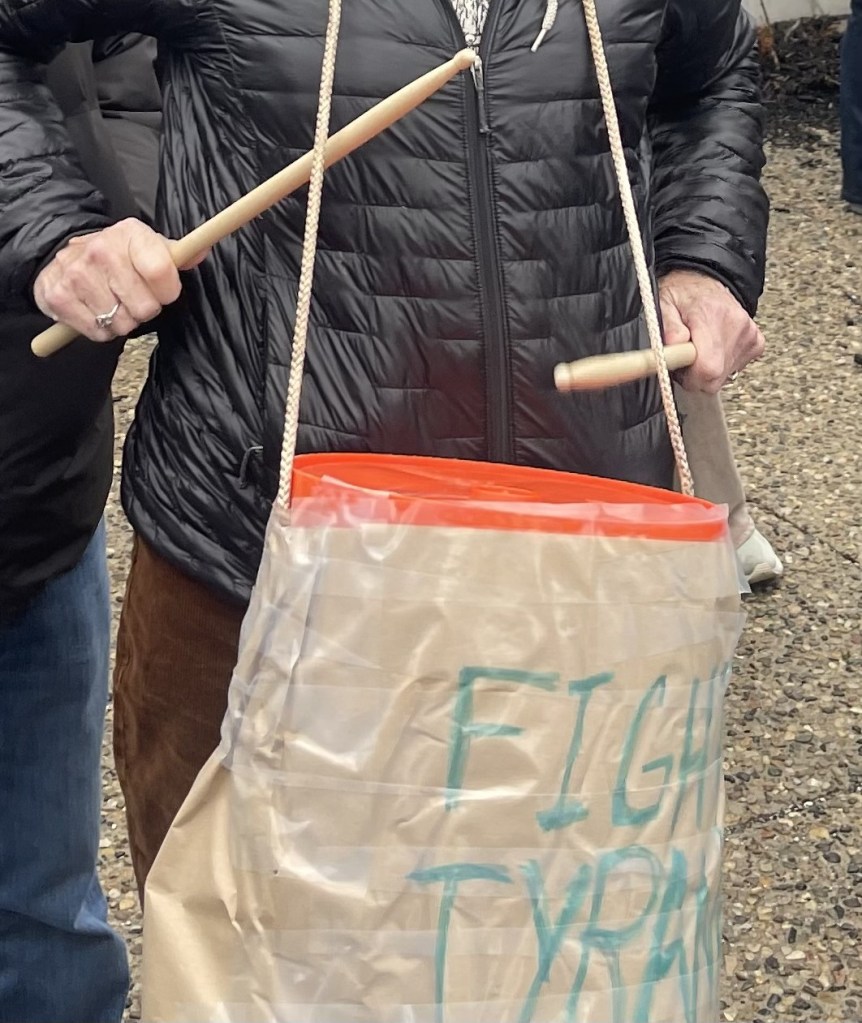
Here in Detroit, six thousand of us gathered outside the Detroit Institute of Arts (DIA) to express our opposition and our growing outrage with the new administration. “Hey, hey; ho, ho. Donald Trump has got to go.” We marched to the beat of the drummers in the crowd. No speeches. No clear leaders. With unshakable determination, we walked 3.7 miles, our hand-painted signs held high.
There was no visible police presence. No incidents. No aggression. There was only one moment of concern, when we came upon a man lying on the sidewalk. An EMS truck with flashing lights stood by and an all-woman crew, out of uniform, were tending the patient. This event had been carefully planned to avoid raising anyone’s emotional temperature.

Trained crossing guards kept watch at every corner, keeping us safe as we navigated through the intersections. We were confined to the sidewalks as normal traffic continued to flow on Woodward Avenue. Car horns repeatedly honked in support. Happy shouts rang out, and arms waved enthusiastically from windows, encouraging us on, briefly taking our minds off our aching feet and the crowded sidewalks.
Stop-go; stop-go. “Hey, hey; ho, ho,” The chant was a constant effort to keep us moving and give us focus. This was a jam-packed sidewalk and for many older people standing still was brutally painful. We supported and assisted each other, community smiles on our faces. We were one.
The crowd felt different from the protests I’d experienced in the past—older and overwhelmingly white. Although there was a scattering of Black families in attendance, many with young children in wagons, others on store steps or benches, watching and waving as they explained to their children the purpose of our demonstration. These parents are building a foundation for their children’s future understanding of the importance of activism.
Here in the center of Detroit, the pushback mobilization against our government suggests a new dynamic. Demonstrators espousing empathy and humanitarian concerns are feeling the sting of personal disenfranchisement. You could see it on their faces. The new administration’s astonishingly successful and careless attempt to destroy our democracy was unfolding, unencumbered by the rule of law. Working class parents are worried about their families, their jobs, medical care, the cost of groceries, and how they will be able to afford to educate their kids.
We have awakened the White Middle Class. But there are additional critical considerations.
The absence of Black and Brown bodies wasn’t apathy, it was history. Black and Brown people have carried this deep and prolonged struggle for generations, fighting a never-ending battle for full citizenship. Now their progress faces enormous odds as the new administration attempts to completely destroy their hard-earned gains.
Shamefully, at the hands of the new administration, both legal residents and U.S. citizens alike live in fear of being dragged into detention or deported from this country to foreign prisons without due process. ICE could be lurking in this or any crowd.
The right to protest is a cornerstone of our democracy. Protests come in all shapes and sizes.
But in this case, one thing puzzled me: where were the police? No officers in riot gear. No barricades. I needed help to understand the lack of policing at the Detroit “Hands Off” action.
Was color the reason no police were visible because the protesters were primarily white?
My niece, Alena, who has partnered with me since 2018, led me to a helpful resource. The Thurgood Marshall Institute has published results of a study on the inequity of police responses to Racial Justice Demonstrations (click here). According to the study, police presence at protests can differ by as much as 40% depending on the protest’s focus. Demonstrations tied to racial justice— like Black Lives Matter or the George Floyd uprisings, see significantly more aggressive policing than so-called non-racial protests.
“Hands Off” was considered a non-racial protest, in which sending police is a tactical decision made by local police departments. Each state has its own laws about policing protests but the right to protest is guaranteed by the First Amendment to the U.S. Constitution.
And yet, on May 22, 2025, just 5 days before the anniversary of George Floyd’s murder by the Minneapolis police, the Trump administration announced that it would abandon efforts to reduce police violence in Minneapolis and six other cities.
_______________________________________________________
The People are rising: It’s been 30 days since the first “Hands Off” and other push-back protests. The demonstrations haven’t stopped. Protesting in large numbers draws attention to people who were previously hesitant to participate. Now they see that nonviolent resistance against the government’s actions is safe. Maybe they will join us the next time.
Protests on a regular schedule demonstrate strength, but we also need rapid response teams when citizens face an emergency breach of civil rights and lack of due process. Many communities have organized rapid response teams for ICE arrests and deportations. Students are also at risk. We all feel vulnerable and exposed, but we are compelled. We won’t back down.
Still, experience teaches us that protests alone aren’t enough. While we take to the streets, we also need to gather in conference rooms and on electronic screens to imagine what comes next. We need options to replace what’s been taken away from us. We need to build the kind of society we want to be.
If we don’t know where we’re going, we’ll get lost. If we don’t build something new to replace the empty space left by our losses, we may win battles, but lose the war.
We need a strategic plan. A real one, like “Project 2025” only in reverse. We need a vision grounded in unity, truth, and enough discipline to carry it through. The Activist’s Survival Guide in my book outlines lessons learned during the Civil Rights Movement. That’s a place to start. Learn, reflect, organize and pass it on.
Thank you for spending a few minutes with us today. Joann
“Courage is contagious.”
 The Activist's Survival Guide
Leave a comment